

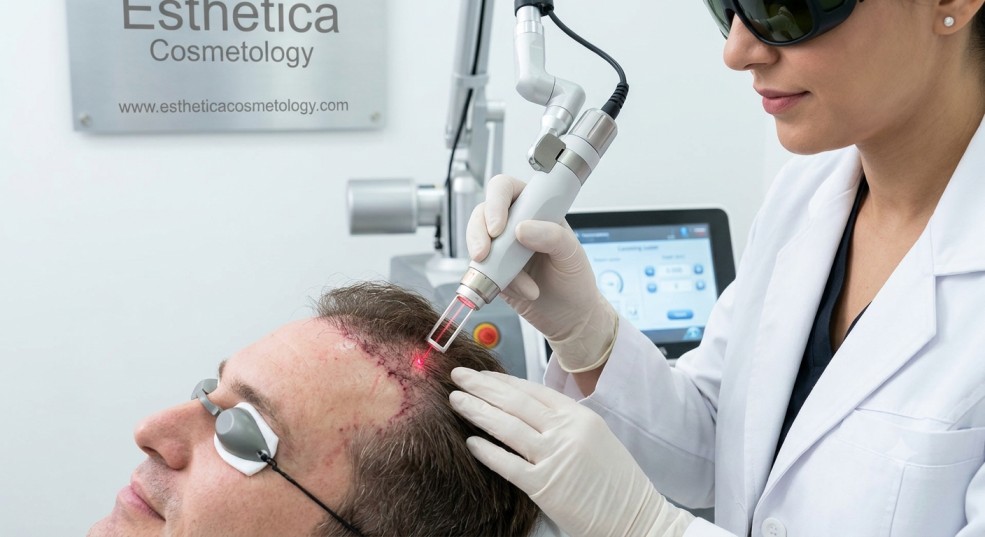
Undergoing a hair restoration procedure comes with expectations of natural density, restored confidence, and a well-contoured hairline. Unfortunately, thousands of patients experience unsatisfactory outcomes due to underqualified practitioners, poor graft placement, unnatural growth angles, or “pluggy” multi-hair graft distribution along the frontal line. When a hair transplant fails to deliver a natural appearance, living with incorrectly placed grafts can cause significant frustration.
For individuals seeking corrective solutions, opting for laser hair removal after failed hair transplant procedures provides an effective, non-surgical method to eliminate misplaced grafts, soften harsh hairlines, and reset the scalp for future repair work. At Esthetica Cosmetology, our expert dermatologists specialize in advanced laser protocols designed to safely target unwanted transplanted hair while protecting delicate scalp tissue.
Why Hair Transplants Fail and Require Correction
A failed hair transplant occurs when transplanted follicles grow unnaturally or fail to integrate seamlessly with the natural hairline. Because transplanted hair is harvested from permanent donor zones (typically the back of the head), these follicles continue to grow indefinitely—even when placed in the wrong position or at incorrect angles.
                  ┌──────────────────────────────────────────────────────────────┐
                  │       Corrective Assessment at Esthetica Cosmetology        │
                  └──────────────────────────────┬───────────────────────────────┘
                                                 │
       ┌─────────────────────────────────────────┼─────────────────────────────────────────┐
       │                                         │                                         │
┌──────▼──────┐                           ┌──────▼──────┐                           ┌──────▼──────┐
│  Misplaced  │                           │   Harsh or  │                           │ Unnatural   │
│  Low Grafts │                           │ Pluggy Line │                           │ Hair Angles │
└──────┬──────┘                           └──────┬──────┘                           └──────┬──────┘
       │                                         │                                         │
       ├─ Lower than natural baseline            ├─ Multi-hair grafts in front row         ├─ Hairs growing straight up/sideways
       └─ Targeted laser reduction               └─ Laser thinning & softening             └─ Laser elimination of misdirected hairs
Common issues that lead patients to seek laser revision include:
Unnaturally Low Hairlines: Implanting grafts too far down the forehead alters natural facial proportions and yields an artificial look.
Harsh, Rigid, or “Pluggy” Front Lines: Natural hairlines consist of fine, single-hair micro-grafts. Placing thick, multi-hair follicular units along the front edge creates a unnatural, doll-like appearance.
Misdirected Hair Growth Angles: If grafts are placed at perpendicular or incorrect angles during implantation, the hair grows straight up or sideways, making it impossible to style naturally.
Asymmetrical or Irregular Placement: Irregular spacing or asymmetrical distribution leaves visible gaps or odd patches along the frontal region.
How Laser Hair Removal Fixes Misplaced Hairline Grafts
Laser hair reduction uses concentrated beams of light targeted at the melanin pigment inside the hair follicle. The light energy converts into heat, disabling the hair root and preventing future growth without requiring invasive surgical extractions.
When dealing with misplaced hair transplants, laser technology offers distinct clinical benefits:
Selective Targeted Reduction: Dermatologists can precisely target individual thick grafts or entire misaligned rows without damaging surrounding native hair.
Softening Coarse Hair Texture: In cases where transplanted donor hair is too coarse for the delicate frontal hairline, controlled laser sessions thin out thick shafts, making the remaining hair appear finer and more natural.
Preparation for Revision Surgery: If you plan to undergo a secondary repair hair transplant, clearing out poorly placed old grafts using laser technology creates a clean canvas for your new surgeon.
Scar-Free Non-Invasive Revision: Surgical extraction (punching out old grafts) can leave tiny round micro-scars. Laser reduction destroys the follicle internally, avoiding additional surgical incision marks.
Laser Removal vs. Surgical Punch Extraction
Understanding your options helps determine whether laser therapy or surgical revision is the right choice for your corrective goals.
| Feature / Consideration | Laser Hair Removal (Esthetica Cosmetology) | Surgical Punch Extraction |
| Invasiveness | Non-invasive optical energy | Minimally invasive surgical punching |
| Downtime | Zero to minimal redness (1–2 days) | Requires wound healing & scabbing |
| Risk of New Scarring | Extremely low when performed by specialists | Risk of tiny hypopigmented punch scars |
| Graft Preservation | Permanently disables target follicles | Extracted grafts can sometimes be re-implanted |
| Best Used For | Wide density reduction, low hairlines, coarse shafts | Removing isolated single pluggy grafts |
Treatment Protocol at Esthetica Cosmetology
Performing laser hair removal after failed hair transplant procedures requires a customized approach due to altered scalp vascularity and previous tissue healing. At Esthetica Cosmetology, we follow a strict clinical protocol to ensure safety and precision.
Step 1: In-Depth Scalp & Hairline Mapping
Our expert dermatologists examine your scalp under magnification to evaluate graft depth, hair thickness, pigment density, and underlying scar tissue from previous surgeries. We collaborate with you to redraw a natural, aesthetically balanced hairline.
Step 2: Patch Test & Parameter Adjustment
Transplanted hair roots often sit deeper in the dermis than natural hair due to surgical placement. We conduct a spot test to select the optimal laser wavelength (such as Diode or Nd:YAG) and pulse duration for safe, effective penetration.
Step 3: Targeted Laser Sessions
During each session, chilled laser tip technology protects the surrounding skin surface while thermal energy targets deep donor follicles. Sessions take 15 to 30 minutes with minimal discomfort.
Step 4: Staggered Cycle Management
Because hair grows in distinct cycles (Anagen, Catagen, Telogen), multiple sessions spaced 4 to 6 weeks apart are required to capture all transplanted follicles in their active growth phase.
Important Expectations and Considerations
Laser Targets Hair, Not Pre-Existing Surgical Scars: While laser treatment permanently stops hair growth, it does not erase pre-existing surgical scars (like FUE micro-dots or FUT strip scars) created during your original transplant.
Permanent Loss of Donor Hair: Hairs eliminated by laser energy cannot be retrieved or used for future hair transplants. Your specialist will carefully mark only the unwanted grafts before starting.
Healing Window Required: If you recently had a hair transplant, you must wait until the scalp has completely healed (typically 6 months post-surgery) before starting laser removal.
Frequently Asked Questions (FAQ)
Can laser hair removal safely remove transplanted hair?
Yes, laser hair removal after failed hair transplant procedures is completely safe when performed by experienced dermatologists. Modern medical-grade lasers precisely target hair pigment to permanently destroy misplaced or unnatural grafts without damaging healthy surrounding skin.
How many sessions are needed to remove misplaced hair transplant grafts?
Most patients require between 4 to 8 laser sessions spaced 4 to 6 weeks apart to achieve complete clearance or desired thinning. Because transplanted donor hair is thick and rooted deeply, multiple passes ensure every follicle in the growth cycle is targeted.
Will laser hair removal cause scarring on my scalp?
No, non-invasive laser treatments do not cause surgical scarring. Advanced cooling technologies used at Esthetica Cosmetology protect the outer skin layer while light energy selectively targets the subterranean hair bulb.
Is laser removal better than punching out old grafts?
Laser removal is ideal if you want to lower hair density, fix an unnaturally low hairline, or avoid new surgical incisions. However, if you want to relocate misplaced grafts to another bald area, surgical punch extraction may be recommended. A consultation at Esthetica Cosmetology helps determine the best path.