

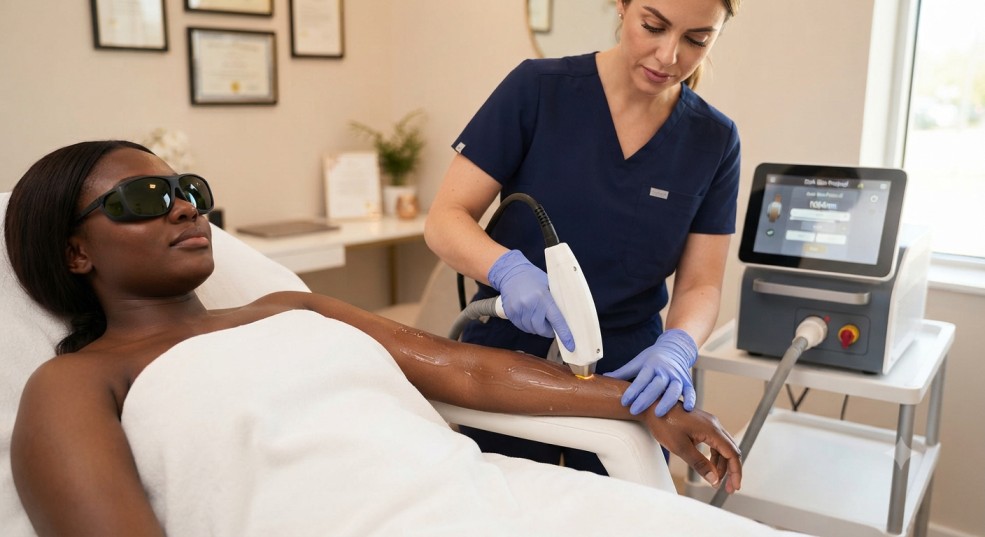
Managing unwanted hair when you have reactive, delicate, or eczema-prone skin can feel like an endless cycle of discomfort. Traditional hair removal methods—such as waxing, plucking, and razor shaving—frequently trigger micro-tears, severe razor bumps, folliculitis, and intense flare-ups of eczema.
Because conventional hair removal often degrades the skin’s moisture barrier, many individuals wonder: Is laser hair removal safe for sensitive skin, or will thermal energy worsen existing irritation?
The short answer is yes, but with important medical caveats. When performed using calibrated equipment under clinical supervision at Esthetica Cosmetology, light-based hair reduction is not only safe but often dermatologist-recommended over traditional shaving and waxing.
Why Traditional Hair Removal Harms Sensitive & Eczema-Prone Skin
To understand why laser energy is often safer than a razor, consider how conventional techniques interact with sensitive skin:
Shaving: Mechanical blades slice hair at the surface while stripping protective lipids from the stratum corneum. This physical scraping causes micro-abrasions, leading to razor burn and triggering eczema flare-ups.
Waxing & Epilation: Mechanically ripping hair roots out of follicles creates localized trauma, pulls on fragile epidermal layers, and leaves open micro-wounds vulnerable to bacterial entry.
Chemical Depilatories: Strong alkaline chemical creams break down hair proteins but can cause severe contact dermatitis and chemical burns on compromised skin barriers.
Barrier Impact Comparison:
Razor Shaving / Waxing ➔ Mechanical Friction & Surface Trauma ➔ High Risk of Eczema Flare-ups
Laser Hair Removal    ➔ Non-Contact Thermal Target of Hair Root ➔ Spares Epidermal Barrier
How Laser Hair Removal Protects Sensitive Skin
Modern dermatological lasers use Selective Photothermolysis. Instead of scraping or pulling the skin surface, the laser emits light energy at a specific wavelength absorbed exclusively by the melanin pigment inside the hair follicle.
Laser Energy Delivery Path:
[Light Energy Emitted] ➔ [Passes Through Surface Skin] ➔ [Absorbed by Hair Root] ➔ [Follicle Disabled]
Because light passes through the surface layer without mechanical friction, laser hair removal eliminates the primary triggers of skin irritation: razor burn, ingrown hairs, and frictional dermatitis.
Laser Hair Removal and Eczema: Essential Safety Guidelines
If you have atopic dermatitis or eczema, safety depends on whether the target area is in an active flare-up or a remission phase.
Key Protocol Guidelines for Eczema-Prone Skin
Treat Only Intact Skin: The target treatment site must be completely healed, calm, and free of active inflammation or scabbing.
Conduct Mandatory Patch Testing: A patch test must be performed 24 to 48 hours prior to a full session to evaluate how delicate skin responds to specific energy densities.
Customize Laser Wavelengths: At Esthetica Cosmetology, practitioners select gentle wavelengths—such as Nd:YAG or cooling-assisted Diode lasers—equipped with advanced sapphire cooling tips to protect delicate surface skin.
Pause Topical Steroids: Discontinue topical corticosteroid creams or immuno-modulators on the target area for 3 to 7 days prior to treatment (under medical guidance) to prevent skin thinning during laser application.
Step-by-Step Clinical Protocol at Esthetica Cosmetology
To guarantee absolute safety and comfort for sensitive skin types, dermatologists follow a carefully structured multi-step care workflow:
Comparing Hair Removal Methods for Sensitive Skin
| Feature / Criteria | Razor Shaving | Waxing / Sugaring | Laser Hair Removal |
| Mechanical Friction | High (blade scrapes epidermis) | Extreme (ripping skin layers) | Zero (non-contact light energy) |
| Risk of Ingrown Hairs | Very High | Moderate to High | Extremely Low (destroys hair root) |
| Eczema Flare Triggering | High | High | Low (only if active flare present) |
| Dermis Penetration | Surface level | Surface level | Targeted follicle depth |
| Long-Term Skin Health | Chronic irritation & dark spots | Barrier disruption | Smooth skin; reduces chronic friction |
Aftercare Rules for Sensitive & Reactive Skin
Maintaining skin barrier health after a session is critical to preventing post-treatment reactivity:
Hydrate Intensely: Apply fragrance-free, ceramide-rich moisturizers to lock in hydration.
Avoid Heat & Friction: Skip hot showers, steam rooms, saunas, intense exercise, and tight synthetic clothing for 24 to 48 hours.
Sun Protection: Apply broad-spectrum mineral SPF 50 (zinc oxide or titanium dioxide) to exposed areas daily.
Avoid Active Topicals: Pause retinoids, AHA/BHA exfoliation, and physical scrubs for at least 5 days post-session.
Frequently Asked Questions
Is laser hair removal safe for sensitive skin on the face or bikini area?
Yes. Facial and bikini areas are prone to severe razor burn and ingrown hairs. Laser hair removal eliminates the need for daily shaving, which ultimately reduces chronic inflammation in these delicate zones.
What should I do if an eczema flare-up occurs right before my scheduled appointment?
Contact Esthetica Cosmetology to reschedule your session. Laser treatment should always be postponed until the eczema flare-up has completely resolved and the skin barrier is intact.
Can laser hair removal help reduce folliculitis and bumps?
Absolutedly. Chronic folliculitis (inflamed hair follicles) and razor bumps are caused by hair shafts curling back into the skin. By disabling the hair follicle permanently, laser treatments eliminate the root cause of folliculitis.
Are cooling systems really effective for sensitive skin during laser sessions?
Yes. Modern medical-grade lasers utilize advanced dynamic cooling devices (such as chilled sapphire tips or cold cryogen sprays) that instantly cool the outer skin layer before and during each pulse, ensuring a comfortable, pain-free experience.