

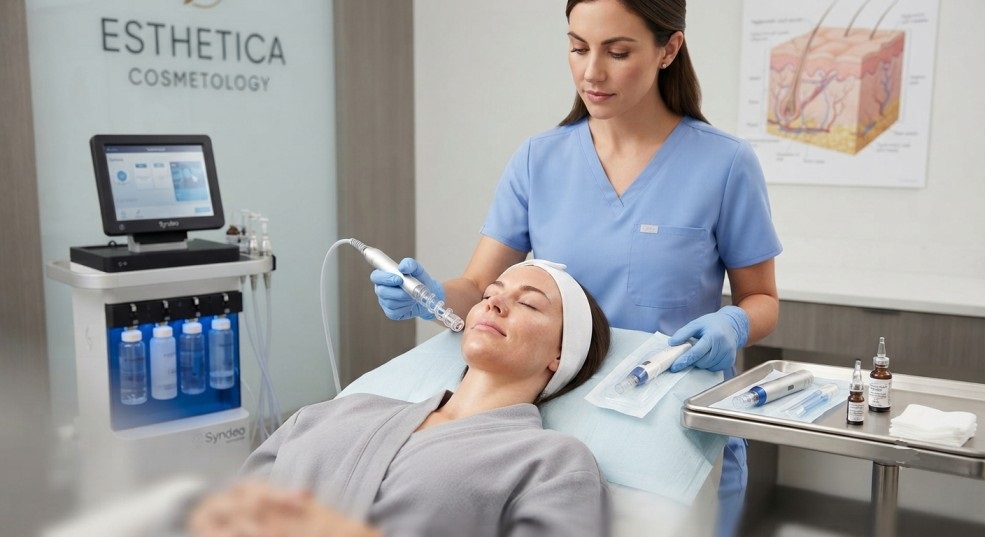
Dealing with persistent acne is frustrating, but living with the pitted scars it leaves behind can impact your self-confidence long after break-outs have cleared up. Traditional treatments like superficial peels or home dermarollers often fall short when addressing deep, structural skin depressions.
Fortunately, advancements in clinical dermatology have transformed scar revision. Microneedling RF for acne scars combines mechanical micro-injuries with localized thermal radiofrequency energy, making it one of the most effective non-surgical options available to smooth deep skin texture, rebuild lost collagen, and refine uneven skin tone.
At Esthetica Cosmetology, scar revision protocols are customized to address the specific depth, type, and severity of your scar tissue.
This guide breaks down how Microneedling Radiofrequency (MNRF) works, compares it to traditional microneedling, outlines realistic recovery expectations, and details the typical cost of restoring your skin matrix.
Understanding Acne Scars: Why Surface Treatments Fall Short
Acne scars form when deep inflammation damages the dermal tissue. As the body attempts to repair the wound, it produces either inadequate or disorganized collagen, resulting in noticeable textural changes on the skin surface.
+-----------------------------------------------------------------------+
|                    COMMON ATROPHIC ACNE SCAR TYPES                    |
|                                                                       |
|  ICE PICK    : Deep, narrow, V-shaped pits extending into the dermis  |
|  BOXCAR      : Angular, sharp-edged round/oval depressions           |
|  ROLLING     : Broad depressions with sloping edges; wavy appearance  |
+-----------------------------------------------------------------------+
The Three Main Atrophic Scar Types
Ice Pick Scars: Narrow, steep punctures that reach deep into the middle layer of the dermis.
Boxcar Scars: Broad, U-shaped depressions with sharp vertical edges.
Rolling Scars: Wide, shallow depressions caused by fibrotic bands tying the skin surface down to deeper tissue, creating a wavy skin texture.
Because these scars root deep within the dermal layer, topical creams and light epidermal exfoliation cannot reach the underlying damage. Rebuilding smooth skin requires stimulating collagen deep within the structural matrix.
How Microneedling RF Works
Microneedling RF (MNRF) combines two proven dermatological therapies into a single, synergistic treatment: Collagen Induction Therapy (CIT) and Radiofrequency Thermal Coagulation.
  MICRONEEDLING RF (Synergistic Dermal Remodeling)
  [Gold-Plated Insulated Microneedles]
            │
            │  ───────► Penetrates 0.5mm - 3.5mm directly into dermis
            ▼
    ░░░░░░░░░░░░░░░░░  (Epidermis remains unharmed / minimal surface trauma)
            │
            ▼
      ┌───────────┐
      │ Thermal   │ ──────► RF Energy emits directly from needle tip
      │ Heat Zone │        Heats targeted dermis (60°C-70°C)
      └───────────┘        Breaks down rigid scar tissue & stimulates new collagen
The Dual-Action Mechanism
Precision Micro-Needling: Ultra-fine, gold-plated microneedles penetrate the skin at precisely controlled depths (ranging from 0.5mm to 3.5mm, depending on scar severity). This mechanical micro-puncture breaks down rigid, fibrotic scar bands.
Targeted Radiofrequency Energy: Once the needles reach the target dermal layer, they emit insulated pulses of radiofrequency heat. This thermal energy heats the surrounding tissue to 60°C–70°C without overheating the outer skin surface (epidermis).
Neocollagenesis & Elastin Remodeling: The combination of physical micro-injury and thermal heat triggers a natural healing response, stimulating the production of fresh collagen and elastin fibers to fill in deep depressions from within.
Microneedling RF vs. Traditional Microneedling
While both treatments use fine needles to stimulate skin repair, adding radiofrequency energy significantly enhances clinical outcomes—especially for deep, stubborn scars.
| Feature | Traditional Microneedling | Microneedling RF (MNRF) |
| Mechanism | Mechanical micro-injuries only | Micro-injuries + Radiofrequency thermal energy |
| Depth Control | 0.5mm to 2.5mm | Deep precision up to 3.5mm |
| Target Layer | Superficial Dermis | Deep Dermis & Sub-dermal Matrix |
| Efficacy for Deep Scars | Moderate (Best for fine lines & light scars) | Very High (Effective for Ice Pick, Boxcar & Rolling scars) |
| Skin Tightening Effect | Minimal | Significant (Heat contracts elastic tissue) |
| Sessions Required | 6 to 8 sessions | 3 to 5 sessions |
| Safety on Indian Skin | Safe | Very Safe (Insulated needles protect surface melanin) |
At Esthetica Cosmetology, insulated microneedling tips are used to ensure the thermal heat bypasses the surface layer of melanin-rich skin, minimizing the risk of Post-Inflammatory Hyperpigmentation (PIH).
Expected Results and Timeline
Pitted scar reduction is a gradual process because collagen synthesis takes time. It helps to understand the timeline from your first session to your final results.
┌────────────────────────────────────────────────────────────────────────┐
│                        COLLAGEN REGENERATION TIMELINE                   │
│                                                                        │
│   Days 1–3   : Initial erythema (redness) & light swelling.           │
│   Week 1     : Micro-crusting sheds; skin texture starts smoothing.    │
│   Weeks 3–4  : Early dermal remodeling & improved skin firmness.       │
│   Months 2–6 : Peak collagen synthesis; visible filling of scar pits.   │
└────────────────────────────────────────────────────────────────────────┘
Immediate Phase (Days 1–3): Skin appears flushed (similar to a mild sunburn) with minor swelling.
Early Healing Phase (Days 4–7): Fine micro-crusts form over the needle insertion points and shed naturally, revealing a fresh skin layer underneath.
Collagen Synthesis Phase (Weeks 3–6): Fibroblasts actively produce new structural collagen. You will notice improved skin firmness and a smoother overall surface.
Peak Results (Months 2–6): Deep scar pits begin to fill from within. Cumulative improvements continue over several months as each treatment session builds upon the last. Most patients achieve a 60% to 80% overall improvement in scar depth and skin texture.
Cost of Microneedling RF Treatment in India
The overall investment for microneedling rf for acne scars varies based on the severity of scarring, the total surface area treated, and the number of sessions required.
Average Price Breakdown
| Treatment Zone | Cost Per Session (INR) | Recommended Sessions |
| Cheeks Only (Localized Scars) | ₹5,000 – ₹9,000 | 3 – 5 |
| Full Face | ₹8,000 – ₹16,000 | 3 – 5 |
| Full Face + Neck | ₹12,000 – ₹22,000 | 3 – 5 |
| Combination Therapy (MNRF + Subcision/PRP) | ₹15,000 – ₹28,000 | 3 – 4 |
At Esthetica Cosmetology, clear pricing and customized packages help ensure your scar revision journey remains cost-effective.
Recovery Guidelines and Skin Care Protocol
Adhering to correct pre- and post-procedure protocols ensures optimal healing and helps protect your skin from hyperpigmentation.
Pre-Treatment Preparation
Pause Exfoliants: Stop using retinoids, salicylic acid, glycolic acid, and benzoyl peroxide 5–7 days prior to treatment.
Avoid Active Breakouts: If you have active cystic acne in the treatment area, your dermatologist may prescribe topical or oral meds to calm inflammation before microneedling.
Stay Hydrated: Drink plenty of water in the days leading up to your session to promote tissue recovery.
Post-Treatment Recovery Care
Keep Skin Clean: Gently clean the face using a mild, non-soap cleanser and lukewarm water starting 12 hours after the session.
Apply Soothing & Repair Serums: Apply hyaluronic acid, ceramides, or post-care healing creams to keep the skin barrier hydrated and calm.
Sun Protection is Mandatory: Avoid direct sun exposure for 7 days post-treatment. Apply a physical broad-spectrum SPF 50+ daily once micro-channels close (24 hours post-procedure).
Do Not Scratch or Pick: Allow any micro-crusts to flake off naturally to avoid post-treatment marks.
Skip Gym and Heat: Avoid intense workouts, saunas, and hot showers for 48 hours to prevent sweat-induced irritation.
Frequently Asked Questions (FAQs)
Q1. Is Microneedling RF painful?
A topical numbing cream is applied 45 to 60 minutes before the procedure. This makes the treatment comfortable, with most patients reporting only mild pressure or a warm prickly feeling over bony contours.
Q2. How many sessions of Microneedling RF are needed for acne scars?
Most individuals require 3 to 5 sessions, spaced 4 to 6 weeks apart, depending on scar depth. Deep ice pick or boxcar scars may require a combination approach with subcision or cross-therapy.
Q3. Is Microneedling RF safe for darker skin tones?
Yes, Microneedling RF is safe for dark and Indian skin types (Fitzpatrick Types III–VI). Because the microneedles enter the dermis before releasing thermal energy, the melanin-rich surface layer is protected from heat, reducing the risk of Post-Inflammatory Hyperpigmentation (PIH).
Q4. What is the recovery downtime for MNRF?
Downtime is minimal. Redness and mild swelling usually clear up within 24 to 48 hours. Light micro-crusting may last up to 5 days, but this is easy to manage and easily disguised with hydrating serums.
Q5. Can Microneedling RF treat active acne?
No, microneedling should not be performed directly over active inflammatory breakouts to avoid spreading bacteria. Active acne must be controlled with targeted clinical care before starting your scar revision plan.
Smooth Your Skin Texture with Esthetica Cosmetology
Deep acne scars do not have to be permanent. With advanced microneedling rf for acne scars, you can stimulate your skin’s natural healing abilities to rebuild lost collagen, smooth uneven texture, and achieve lasting skin clarity.
At Esthetica Cosmetology, experienced clinical dermatologists tailor every microneedling protocol to match your specific scar patterns and skin sensitivity.
Ready to start your scar revision journey?
Book your personalized skin assessment at Esthetica Cosmetology today and discover how Microneedling RF can restore smooth, confident skin!