

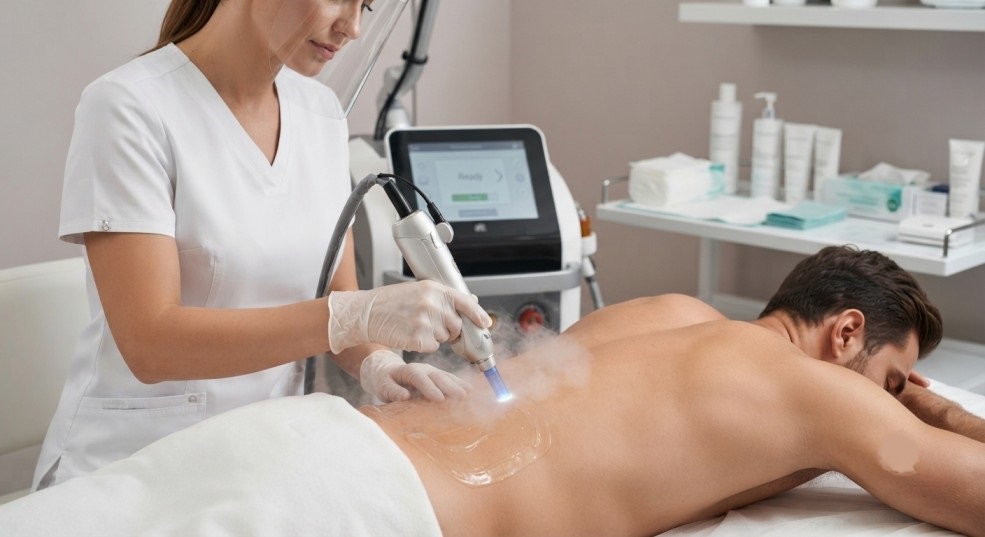
Tattoos are a beautiful form of self-expression, while smooth, hair-free skin is a convenience many people love. However, if you have ink in areas where you want smooth skin, you might wonder how these two aesthetic choices interact. A very common question asked in clinical consultations is: Can you get laser hair removal on tattoos safely?
The short answer is no, you cannot run a hair removal laser directly over tattooed skin. Doing so can damage both your tattoo art and your underlying skin tissue. However, you can safely receive treatment in surrounding areas with the right techniques and protective protocols.
At Esthetica Cosmetology, safety always comes first. Laser specialists routinely help clients manage body hair around existing ink while keeping their body art fully protected.
In this comprehensive guide, we will explore the science behind laser hair removal on tattoos, why direct laser contact is unsafe, how to remove hair around tattooed areas, and what alternatives exist for inked skin.
The Science: How Hair Removal Lasers Interact with Ink
To understand why hair removal lasers cannot be used directly over a tattoo, it helps to understand how laser hair removal technology functions.
Laser hair removal relies on a process known as selective photothermolysis. The laser emits a specific light wavelength that targets melanin (pigment) at the base of the hair follicle. The pigment absorbs the light energy, converting it into heat that destroys the hair root to prevent future growth.
       DIRECT LASER APPLICATION ON TATTOOS (WHAT HAPPENS)

       Laser Light Emitted
              │
              ▼
       Targets Dark Pigment
              │
              ├───────────────────────────────┐
              ▼                               ▼
       Absorbed by Hair Follicle      Absorbed by Tattoo Ink
       (Intended Target)              (UNINTENDED TARGET)
              │                               │
              ▼                               ▼
       Hair Reduction                Extreme Heat Absorption
                                              │
                                              ▼
                                      Blistering, Scarring,
                                      & Tattoo Distortion
The primary issue is that the laser cannot distinguish between the dark pigment in your hair root and the dark pigment in tattoo ink. When a hair removal laser passes directly over tattooed skin, the following occurs:
Rapid Overheating: Tattoo ink absorbs massive amounts of light energy instantly, generating intense heat within seconds.
Severe Skin Damage: This extreme thermal reaction can cause third-degree burns, severe blistering, skin peeling, and permanent scarring.
Tattoo Distortion: The heat breaks down the ink particles beneath the skin, causing your tattoo design to fade, bleed, smear, or discolor completely.
Laser Hair Removal vs. Laser Tattoo Removal: What’s the Difference?
A common misconception is that because both procedures use lasers, a hair removal laser will simply fade a tattoo gracefully. In reality, hair removal lasers and tattoo removal lasers operate on fundamentally different wavelengths and pulse durations.
| Feature | Laser Hair Removal | Laser Tattoo Removal |
| Primary Target | Melanin in active hair follicles | Artificial ink pigments in the dermis |
| Laser Pulse Speed | Milliseconds (longer heating to destroy follicle) | Nanoseconds or Picoseconds (ultra-fast shockwaves) |
| Mechanism | Sustained thermal destruction | Shattering ink particles into micro-fragments |
| Effect on Tattoos | Accidental thermal burns and distorted ink | Controlled breaking down of ink for body elimination |
Attempting to treat hair over a tattoo with a hair removal device creates thermal damage rather than controlled ink removal.
How to Safely Treat Skin Around Tattoos
Having tattoos does not mean you must give up on laser hair removal entirely. You can safely treat areas near your tattoos by following strict clinical masking protocols.
+-------------------------------------------------------------------+
|               SAFE LASER PROTOCOL NEAR TATTOOED SKIN              |
+-------------------------------------------------------------------+
|  1. Professional Mapping & Assessment                             |
|     -> Identify tattoo boundaries & measure safety buffer zone.   |
+-------------------------------------------------------------------+
|  2. Physical Masking & Barrier Creation                            |
|     -> Cover ink with medical-grade barriers or white templates.  |
+-------------------------------------------------------------------+
|  3. Precision Perimeter Treatment                                 |
|     -> Treat un-inked skin maintaining a strict 2-3 cm distance.  |
+-------------------------------------------------------------------+
1. Maintain a Safety Buffer Zone
A certified practitioner will establish a strict 2 to 3-centimeter safety margin around the outer border of your tattoo. This prevents heat scatter from affecting the edges of your ink.
2. Physical Covering and Masking
Before starting the treatment, your practitioner will cover the tattoo completely using specialized physical barriers, such as white medical tape, thick wooden depressors, or custom templates. Light colors reflect laser energy, preventing accidental light exposure.
3. Customized Area Planning
If you are planning to get a full sleeve, backpiece, or leg tattoo, the best strategy is to complete your laser hair removal on tattoos areas before getting inked.
At Esthetica Cosmetology, clinicians often advise clients to finish their full laser hair removal course prior to visiting their tattoo artist. This gives you hair-free skin while protecting your future tattoo investment.
What Happens if a Tattoo is Accidentally Hit by a Hair Laser?
If an inexperienced technician accidentally fires a hair removal laser over your tattoo, immediate action is required to minimize long-term skin damage.
Immediate Side Effects:
Instant Stinging/Burning: Intense discomfort beyond normal laser sensation.
Blistering & Swelling: Rapid swelling and fluid-filled blisters over the inked design.
Skin Depigmentation: White or hyperpigmented patches forming across the tattoo.
Immediate First-Aid Steps:
Cool the Area Instantly: Apply cold compresses or ice packs wrapped in a clean cloth to draw out excess heat.
Apply Soothing Ointments: Use pure aloe vera or recommended barrier repair ointments to keep the skin hydrated.
Never Pop Blisters: Popping blisters greatly increases the risk of bacterial infection and permanent scarring.
Seek Professional Evaluation: Visit a medical clinic promptly to assess burn depth and receive proper wound-care instructions.
Safe Hair Removal Alternatives for Tattooed Areas
Since laser treatment cannot touch the tattooed area directly, how do you manage hair growing over your ink? Here are the safest alternative hair removal methods for tattooed skin:
1. Shaving
Safety Rating: 10/10
Why it Works: Shaving removes hair at the surface level without penetrating the dermis where your tattoo ink resides. It is completely safe for healed tattoos and will not cause fading.
2. Electrolysis
Safety Rating: 9/10
Why it Works: Electrolysis uses a micro-probe inserted directly into individual hair follicles, delivering a tiny electrical pulse. Because it does not rely on light absorption or pigment targeting, it can safely remove hair directly over tattooed skin when performed by a licensed electrologist.
3. Waxing / Sugaring
Safety Rating: 8/10
Why it Works: Waxing pulls hair from the root without affecting sub-dermal ink layers. However, ensure your tattoo is fully healed (at least 2–3 months old) before waxing to prevent skin trauma.
Pre-Treatment & Post-Treatment Checklist for Inked Clients
If you are planning a session for laser hair removal on tattoos adjacent areas, keep this checklist in mind:
       PRE-TREATMENT CHECKLIST
       [ ] Ensure all nearby tattoos are 100% healed (minimum 3 months old)
       [ ] Shave un-inked treatment areas 24 hours prior
       [ ] Inform your technician about all tattoo locations
       [ ] Avoid sun exposure & tanning 2 weeks before treatment

       POST-TREATMENT CHECKLIST
       [ ] Apply cold compresses to surrounding skin if warm
       [ ] Moisturize with gentle, fragrance-free lotions
       [ ] Wear broad-spectrum SPF 50+ on exposed areas
       [ ] Avoid hot tubs, saunas, and heavy workouts for 48 hours
Expert Recommendations: Timing Your Ink and Laser Sessions
If you want both smooth skin and fresh tattoos, proper scheduling is essential.
Laser First, Tattoo Second: Complete your full laser hair removal series (typically 6–8 sessions) on the target area first. Once skin is smooth and healed, wait 4–6 weeks before getting your new tattoo.
Work Around Existing Ink: If you already have tattoos, work with experienced medical professionals who use careful masking techniques to treat surrounding hair safely.
Consulting with skilled specialists at Esthetica Cosmetology ensures your skin receives treatment safely while preserving your body art.
Frequently Asked Questions (FAQs)
Can laser hair removal fade my existing tattoo?
Yes. If a hair removal laser touches your tattoo directly, it can shatter the ink particles and cause significant fading, smudging, or permanent color distortion alongside skin burns.
How close to my tattoo can the laser get safely?
Specialists recommend keeping a safety margin of at least 2 to 3 centimeters around the perimeter of the tattoo. Physical barriers should cover the ink throughout the session.
Can I get laser hair removal over a white or light-colored tattoo?
No. Even light-colored or white tattoo inks contain pigments that absorb laser energy unpredictably. Treat all tattoos, regardless of color or size, with the same safety protocols.
What should I do if I want a new tattoo on an area I am currently treating with lasers?
Complete your full course of laser hair removal first. Once your final laser session is complete and your skin has recovered for 4 to 6 weeks, you can safely get your new tattoo over the hair-free area.
Final Thoughts
Can you safely navigate laser hair removal on tattoos? Yes—as long as the laser treats the surrounding skin while leaving the tattoo itself untouched.
Direct laser contact with tattoo ink can lead to burns, scars, and ruined body art. However, with physical masking, protective buffer zones, and alternative hair removal methods for inked sections, you can enjoy smooth skin without compromising your tattoos.
Prioritize safety and expert care for your skin and art. Book your personalized consultation with Esthetica Cosmetology today to create a custom laser hair removal plan that protects your tattoos while delivering exceptional results!