

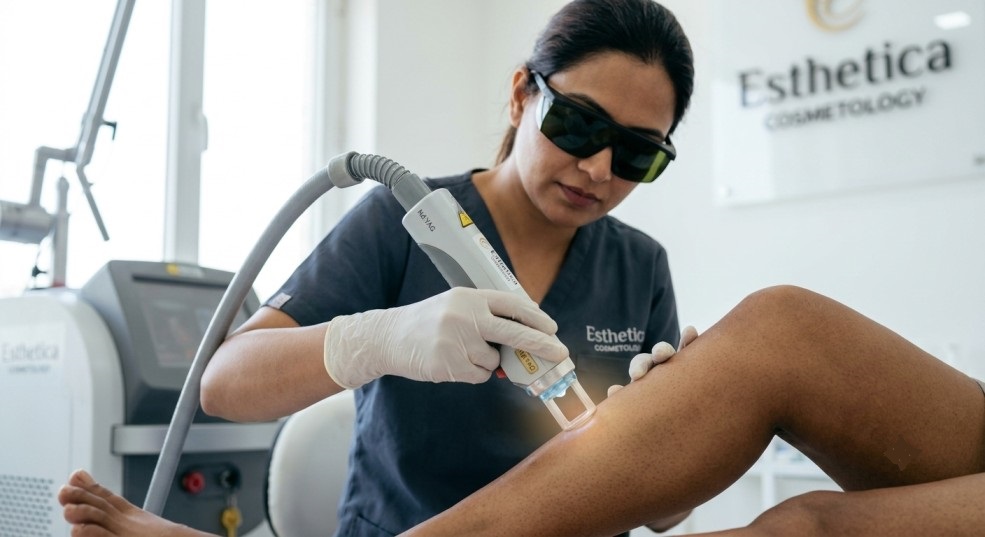
Achieving smooth, hair-free skin through laser treatments has become one of the most popular aesthetic procedures worldwide. However, for individuals with medium, wheatish, or deeply pigmented Indian skin tones, a persistent worry remains: Can laser energy cause burns, dark spots, or skin damage on melanin-rich skin? If you have ever asked is laser hair removal safe for wheatish and dark indian skin, the definitive medical answer is yes—when performed with the correct laser wavelength and expert clinical protocols.
Historically, early-generation lasers were designed primarily for fair skin with dark hair, making them risky for darker complexions. Today, state-of-the-art dermatological technology has completely eliminated these barriers. At Esthetica Cosmetology, our medical aesthetic specialists utilize advanced, specialized laser systems engineered specifically to protect epidermal melanin while delivering powerful, permanent hair reduction.
The Physics of Laser Hair Removal and Indian Skin Tones
To understand why skin tone matters during laser treatments, it helps to examine how light energy interacts with human tissue.
Laser hair removal operates on the principle of selective photothermolysis. The laser emits a precise beam of light energy that targets melanin (the pigment that gives hair its color). The hair shaft absorbs this light, converts it into thermal heat, and destroys the hair follicle at the root to prevent future regrowth.
The Fitzpatrick Scale and Melanin Density
Dermatologists categorize human skin into six distinct phototypes using the Fitzpatrick Scale:
Types I–III: Fair to light olive skin with low surface melanin.
Types IV–VI: Wheatish, brown, and dark brown skin typical of South Asian and Indian complexions, characterized by high surface (epidermal) melanin.
Because Indian skin carries higher levels of melanin in the upper layer of the skin (epidermis), older laser devices could not easily differentiate between the pigment in the skin and the pigment in the hair follicle. If surface melanin absorbs the laser light, it can result in side effects like hyperpigmentation (dark patches), hypopigmentation (light patches), or superficial burns. Modern medical lasers overcome this by using specific, deeper-penetrating wavelengths.
Comparing Laser Technologies: Nd:YAG vs. Diode for Indian Skin
Not all laser devices are created equal. Choosing the right technology is the single most crucial factor in ensuring treatment safety on wheatish and dark Indian skin tones.
                   ┌─────────────────────────────────────────┐
                   │  Laser Wavelength Depth Comparison      │
                   └────────────────────┬────────────────────┘
                                        │
        ┌───────────────────────────────┴───────────────────────────────┐
        ▼                                                               ▼
┌───────────────────────────────┐               ┌───────────────────────────────┐
│  Diode Laser (808nm–810nm)    │               │  Nd:YAG Laser (1064nm)        │
├───────────────────────────────┤               ├───────────────────────────────┤
│ • Moderate Penetration        │               │ • Deepest Penetration Depth   │
│ • High Melanin Absorption     │               │ • Low Surface Absorption      │
│ • ✅ Ideal for Types III–V     │               │ • ✅ Gold Standard Types V–VI  │
│   (Wheatish & Medium Skin)    │               │   (Deep / Dark Skin Tones)    │
└───────────────────────────────┘               └───────────────────────────────┘
1. The 1064nm Nd:YAG Laser (The Gold Standard for Dark Skin)
The Neodymium-doped Yttrium Aluminum Garnet (Nd:YAG) laser operates at a long wavelength of 1064 nanometers (nm).
How it works: Because 1064nm light has a lower absorption rate in surface melanin, it passes completely through the upper skin layer without disturbing epidermal pigment. It reaches deep into the dermis to target the vascular supply feeding the hair follicle base.
Safety Profile: It offers the highest safety margin for Fitzpatrick Types V and VI, virtually eliminating the risk of surface burns or post-inflammatory hyperpigmentation.
2. The 808nm / 810nm Diode Laser (Versatile for Wheatish Tones)
Diode lasers operate in the 808nm to 810nm wavelength range, striking a balance between melanin absorption and tissue penetration.
How it works: Modern Diode devices feature ultra-short pulse durations paired with advanced contact cooling tips. This chills the outer skin instantly before, during, and after each laser pulse.
Safety Profile: Exceptionally effective and safe for wheatish and olive skin tones (Fitzpatrick Types III to V), making it ideal for thick, coarse hair on both the face and body.
3. Technologies to Avoid on Dark Skin (Alexandrite & IPL)
755nm Alexandrite Laser: High melanin absorption makes it prone to causing burns on wheatish or dark skin.
IPL (Intense Pulsed Light): IPL is broad-spectrum light rather than a true monochromatic laser. It is scattered and unreliable for dark skin phototypes.
Clinical Comparison: Matching Laser Tech to Indian Skin Phototypes
Evaluating how different laser platforms interact with South Asian skin types highlights why custom-tailored settings are essential:
| Feature | Diode Laser (808–810nm) | Nd:YAG Laser (1064nm) | Traditional Alexandrite / IPL |
| Recommended Skin Types | Fitzpatrick Types III, IV & V (Wheatish to Brown) | Fitzpatrick Types IV, V & VI (Dark Brown to Black) | Fitzpatrick Types I–III (Fair Skin Only) |
| Melanin Safety Profile | High (When combined with contact cooling) | Maximum / Gold Standard for Melanin | Low (High risk of surface burns) |
| Penetration Depth | Medium-Deep | Very Deep (Reaches bulb & papilla) | Shallow |
| Best Target Hair | Coarse to medium dark body hair | Coarse, deep-rooted facial/body hair | Fine dark hair on fair skin |
| Risk of Pigmentation | Very Low | Minimal to None | High on darker complexions |
Essential Safety Protocols at Esthetica Cosmetology
At Esthetica Cosmetology, we prioritize skin health above all else. Performing laser hair removal on wheatish or dark Indian skin requires clinical expertise, strict patch testing, and personalized energy customization.
Here is how our clinical team ensures 100% safe, comfortable, and predictable outcomes:
Mandatory Skin Phototype Assessment: Before starting treatment, our clinical experts evaluate your skin using the Fitzpatrick scale, checking recent sun exposure and underlying hormonal factors like PCOS.
Pre-Treatment Patch Testing: We perform a spot test on a small, discreet area of your skin using conservative energy parameters to observe your skin’s thermal response over 24 to 48 hours.
Integrated Contact Cooling Technology: Our advanced laser handsets feature dynamic sapphire cooling systems that keep the epidermis chilled at near-freezing temperatures throughout the session, eliminating discomfort and thermal buildup.
Customized Energy Fluence: We gradually adjust the pulse duration and energy fluence based on how your skin responds across successive sessions, ensuring maximum hair follicle destruction with zero epidermal harm.
Pre-Care and Post-Care Guidelines for Indian Skin Types
To prevent temporary redness or accidental hyperpigmentation when undergoing laser treatment on darker skin, adhere to these simple clinical guidelines:
Pre-Treatment Protocols:
Avoid Active Sun Exposure: Skip tanning, direct beach sun, or outdoor sports without protection for 2 weeks prior to your session, as freshly tanned skin accumulates extra surface melanin.
Shave, Do Not Wax: Shave the treatment area 12–24 hours before your session. Do not wax, pluck, or thread for 3 weeks prior, as the hair root must remain intact for the laser to target.
Stop Aggressive Actives: Pause topical retinoids, glycolic acid, or strong exfoliating serums on the treatment area 3 to 5 days before treatment.
Post-Treatment Protocols:
Apply Soothing Gel: Use pure aloe vera gel or prescribed anti-inflammatory creams if mild redness or perifollicular edema (slight swelling around hair shafts) occurs.
Apply Broad-Spectrum Sunscreen: Protect exposed treated areas with a broad-spectrum SPF 50 sunscreen daily to prevent UV-induced pigmentation.
Avoid Hot Showers and Saunas: Refrain from hot baths, steam rooms, intense workouts, or swimming pools for 24 to 48 hours post-treatment to keep the skin cool.
Frequently Asked Questions (FAQ)
Is laser hair removal safe for wheatish and dark Indian skin?
Yes, laser hair removal is completely safe for wheatish and dark Indian skin when performed using long-wavelength devices like 1064nm Nd:YAG or 810nm Diode lasers with built-in cooling technology. These devices bypass surface melanin to target the hair root safely.
Does laser hair removal cause hyperpigmentation on darker skin?
Hyperpigmentation only occurs if incorrect laser wavelengths, excessive heat settings, or non-medical IPL devices are used. When treated by experienced clinicians at Esthetica Cosmetology using appropriate Nd:YAG or Diode parameters, the risk of pigmentation changes is minimal.
How many sessions are required for dark Indian skin?
Most clients with Indian skin types require 6 to 8 sessions spaced 4 to 6 weeks apart to achieve long-term hair reduction up to 80–90%. Coarse facial hair or underlying conditions like PCOS may require periodic maintenance sessions.
Is laser hair removal painful on dark skin?
Modern laser devices equipped with advanced sapphire contact cooling make the procedure highly tolerable. Most patients describe the sensation as a light snap or mild warmth rather than pain.
Conclusion
The question of is laser hair removal safe for wheatish and dark indian skin comes down to technology and clinical expertise. Thanks to advanced 1064nm Nd:YAG and Diode laser systems, individuals with melanin-rich complexions no longer have to worry about skin safety while seeking permanent hair reduction.
Ready to experience safe, medical-grade laser hair removal tailored specifically to your unique skin tone? Visit Esthetica Cosmetology today to book your comprehensive skin assessment and patch test with our experienced clinical team!